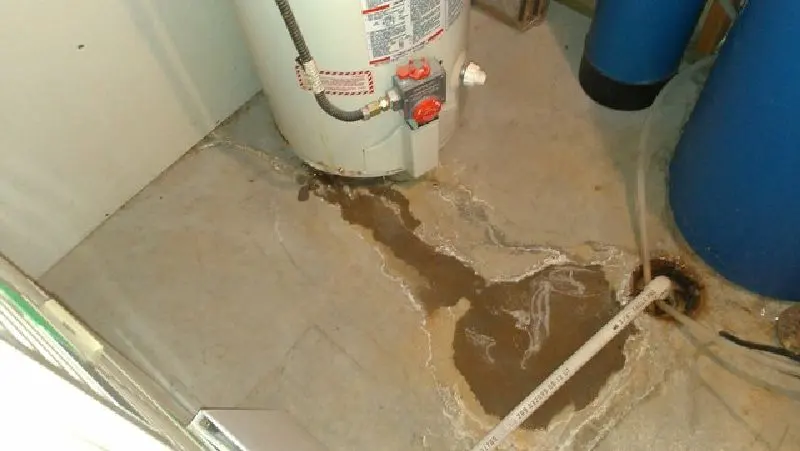
A tank water heater holds enough water to soak a closet, utility room or garage floor, and a leak from the base often gives little warning before the damage is done. In Flat Rock, the city's plumbing permit application lists water heaters, tank and tankless, among its items, and the Building and Safety page lists plumbing inspections on Thursday mornings only. Both facts shape how a leak is cleaned up and how the replacement is scheduled.
Key takeaways
- A leaking tank is replaced rather than patched, and the drying and the replacement are best planned together.
- Flat Rock's plumbing permit application lists water heaters, tank and tankless, among its items.
- The city's Building and Safety page lists plumbing inspections on Thursday mornings only, so timing matters when a replacement needs one.
- Shut off power or gas to the heater and close the cold water inlet first, if it can be done safely.
- Where the tank sits changes the damage: a closet leak runs into walls, a garage leak spreads across the floor and a basement leak soaks whatever is stored below.
How water heaters leak: tanks, pans and tankless units
Tanks are lined to protect the steel, and over time the lining wears and small leaks begin at fittings, valves or seams. A weeping valve or a damp base is often the first warning.
- Water or rust stains around the base of the tank
- A relief valve that drips or weeps
- Rust colored hot water from the tap
- Rumbling or popping while the heater runs
- A tank old enough that replacement is already on the list
Slow weep or sudden failure
Not every leak is slow. A seam can split and release the whole tank, which is enough water to flood a small room.
Drain pans and their limits
A drain pan under a tank catches small drips, and a pan with a drain pipe carries them to a safe place. A full tank failure can overwhelm even a good pan, and a pan without a drain simply fills.
- A pan catches drips from fittings and valves, not the contents of a split tank.
- A pan only helps if its drain pipe is clear and runs to a safe spot.
- An older metal pan can rust through and stop catching anything.
Tankless units leak differently
The city's permit application covers tankless units as well as tanks. A tankless unit holds little water, so a leak usually comes from a fitting, a valve or a condensate drain.
These leaks are often slow, and slow leaks can soak a wall cavity or a cabinet base for weeks before a stain appears.
What to shut off first
Stopping the supply comes before cleanup, and the order matters for safety.
- For an electric heater, turn off its breaker; for a gas heater, turn the gas control to off.
- Close the cold water inlet valve above the tank.
- If the floor is wet around electrical equipment, stay out and shut off power only from a dry panel.
- If there is any gas smell, leave the house and call the gas utility.
- Do not turn the heater back on until a plumber confirms the tank is full and sound.
Flat Rock's permit application and Thursday inspections
The City of Flat Rock's plumbing permit application lists water heaters, tank and tankless, backflow preventers, floor drains, traps and backwater valves, and sump and ejector pumps among its permit items.
Whether a given job needs a permit is a question for the Building and Safety office, so it is worth asking before the old tank comes out.
Flat Rock's 4,169 housing units run from houses built before 1940 to new construction, and 804 of them are mobile homes, so tanks sit in many different spaces, from closets and utility rooms to garages and, in homes that have one, basements.
- Water heaters, tank and tankless
- Floor drains, traps and backwater valves
- Sump and ejector pumps
- Backflow preventers, with a certification test report needed for main and bypass devices
Why Thursday matters
Flat Rock's Building and Safety page lists plumbing inspections on Thursday mornings only.
That limits when an inspector can look at new work, so the plumber, the restoration team and the owner all gain from agreeing on a schedule before the old tank is removed.
- Ask the plumber whether the job needs an inspection and when it will be requested.
- Leave opened wall sections accessible until the plumber confirms whether an inspector needs to see the work.
- Keep the restoration team informed of the replacement date so drying equipment is not disturbed.
Where the tank sits changes the cleanup
A closet or interior room
Water runs into wall framing, under flooring and, on an upper floor, through the ceiling below.
A garage or utility room
Water spreads across the floor and under walls and cabinets, and it can reach stored items and the base of nearby framing.
A basement
Water soaks stored items and finished materials and heads for the floor drain. Flat Rock's median home was built in 1985, and 1,869 of its 4,169 homes predate 1980, so the structures involved span several building eras.
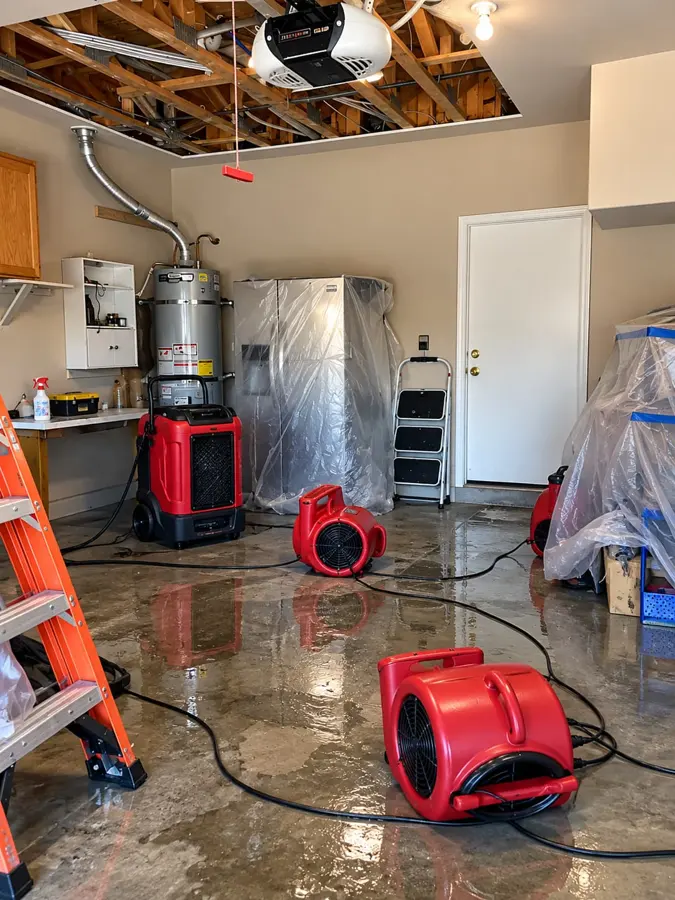
The walkthrough, extraction and drying
The job runs in a set order: a walkthrough, then extraction, then drying.
The walkthrough
The tech who does the walkthrough maps the wet area before anything is opened.
- A moisture meter checks the walls and floor around the tank.
- A thermal camera shows cool, wet areas behind surfaces.
- The plan lists what is removed, what is dried and how readings will be logged.
Extraction and drying
The extraction crew removes standing water first, and the drying team then checks walls, flooring and cabinets with moisture readings. Water extraction in Flat Rock comes before any drying equipment is set.
A full water heater leak cleanup in Flat Rock ends when the readings match a dry reference.
- Wet insulation around or under the tank is removed rather than dried in place.
- Drywall that wicked water upward is cut out above the wet reading.
- Flooring is lifted where water has gone under it.
- Air movers and dehumidifiers run, and readings are logged each day.
Insurance and records
Policies often treat a sudden tank failure differently from slow seepage over time, and the tank itself may be handled differently from the water damage it caused. The policy wording decides.
A clear file helps either way, and the Flat Rock water damage pros keep one as the drying runs.
- Photos of the tank, its base and the failed part, with dates
- The age of the tank, if the label can be read
- The plumber's invoice and the date of the replacement
- The moisture readings and removal records from the drying team
Questions
How can a homeowner tell a water heater is wearing out?
Rust at the base, a relief valve that drips, rust colored hot water and rumbling while the heater runs are common signs. An older tank is more likely to fail from internal corrosion.
Can a leaking water heater be repaired?
A leaking tank is replaced, because patching a corroded tank does not hold. A leaking fitting or valve can sometimes be fixed by a plumber, which is worth finding out before the whole unit is replaced.
Does Flat Rock require a permit to replace a water heater?
The city's plumbing permit application lists water heaters, tank and tankless, among its items. Whether a specific job needs a permit is a question for the Building and Safety office, and the plumber can usually confirm it.
When are Flat Rock plumbing inspections held?
The Building and Safety page lists plumbing inspections on Thursday mornings only, so it is worth confirming the schedule with the city before work begins.
Is water heater damage covered by homeowners insurance?
Often the water damage from a sudden failure is covered while the tank itself is not, but policies differ. The wording and the cause decide.
Does a tankless water heater leak the same way as a tank?
Less often in volume. A tankless unit holds little water, so leaks usually come from fittings, valves or a condensate drain, and they are often slower.