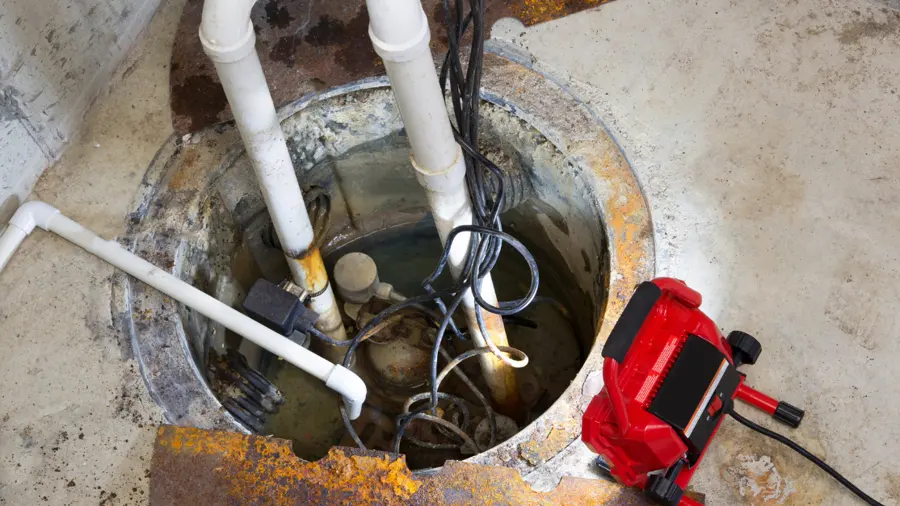
A sump pump does its most important work when the rain is heaviest, and that is also when it is most likely to fail. On July 19, 2019, a storm brought heavy rain, wind and power outages to the Downriver area, and the News-Herald listed Woodhaven among the cities with flooded roads and power outages. A pump cannot run without power, and Woodhaven's poorly drained clay gives rain few places to go.
Key takeaways
- A sump pump cannot run without power, and a stuck float, a burned out motor or a blocked discharge pipe stops it just as completely.
- The July 19, 2019 storm brought flooded roads and power outages to Woodhaven, and police said Hall Road was by far the hardest hit.
- About half of Woodhaven's land is Hoytville silty clay loam, a clayey soil that is somewhat poorly to poorly drained.
- Water that rises from a sump pit is not clean, so soaked carpet, pad and drywall are judged for removal and the rest is extracted and dried.
- Testing the pump, float and discharge pipe before storm season is the simplest way to catch a weak pump early.
Why a pump fails when the rain is heaviest
A sump pit collects water from around the foundation, and the pump moves it out of the house. The system is simple, which also means one weak part can stop it.
Heavy rain pushes every one of those parts to its limit.
- Power loss: a storm that knocks out electricity stops the pump with no warning.
- Stuck float: a float that jams against the pit wall never tells the motor to start.
- Worn motor: a pump that has run hard for years can burn out when it runs without a break.
- Blocked or frozen discharge: water has nowhere to go even while the motor runs.
- Undersized pump: a pump that kept up with ordinary rain can fall behind in a cloudburst.
What Woodhaven's July 2019 storm showed
Flooded roads and lost power
On Friday, July 19, 2019, the News-Herald reported heavy rain, wind and power outages across the Downriver area, with Woodhaven among the cities reporting flooded roads and outages.
Woodhaven police said Hall Road was by far the hardest hit, and a News-Herald photo credited to the department shows flooding in the area of Hall Road north of West Road.
Warnings from the police
Police warned residents not to drive through flooded areas, and city workers helped some residents. The reports describe roads and outages, not failed pumps, but a storm that floods roads and cuts power is exactly the kind in which a pump matters most.
- Hall Road: described by police as by far the hardest hit
- Deerfield Estates, West Road, Chipmunk Trail and Buckingham: areas police told drivers to avoid
- Citywide: flooded roads and power outages reported across Woodhaven
Poorly drained clay on flat ground
About half of Woodhaven's land is Hoytville silty clay loam, a clayey soil on low, flat ground that is somewhat poorly to poorly drained.
The Wayne County Soil Survey, quoted in the city's Master Plan, says the low depressional areas of that soil are subject to flooding for brief periods by water runoff. Woodhaven is relatively flat, and its lowest ground is in the eastern part of the city near Lower Constitution Park.
- Rain that cannot soak in moves across the surface toward low spots.
- Where a home relies on a sump pump, the pump may run longer and more often in a wet spell.
- Standing water around a foundation is more likely to find a way in once the pump is off.
What to do when the pump quits and water rises
Safety comes before the water. A pit in a wet lower level sits near outlets, cords and sometimes a panel, so power should be treated as live until it is checked.
The steps below protect people first and the claim second.
- Stay out of standing water if outlets, cords or the panel are wet, and switch off power only from a dry spot.
- Check the simple causes from a safe position: the breaker, the outlet and whether the float moves freely.
- Move valuables, boxes and electronics up and out of the way.
- Photograph the water level, the pit and the discharge pipe before anything changes.
- Note when the power went out and when the water started to rise.
- Call a restoration team once water is above the floor, since the pit is only part of the problem.
What extraction and drying involve
Water that rises from a sump pit is groundwater and storm runoff that has touched soil and the pit itself. It is not clean, so the plan depends on what it reached.
Extraction first
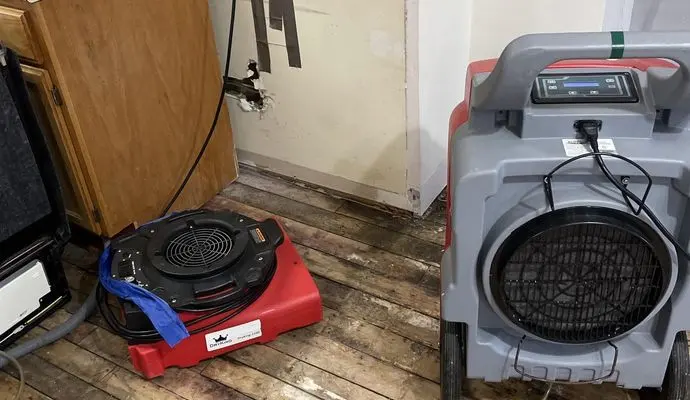
The extraction crew pumps the lower level out with portable or truck mounted units, then lifts soaked carpet and pad. Water extraction in Woodhaven comes before any drying, because wet materials keep wicking water up into walls.
Drying to a reading
The drying team runs air movers and dehumidifiers, opens wall cavities where moisture is trapped and logs readings each day. With a median build year of 1979 and 2,973 homes that predate 1980, Woodhaven's housing spans several building eras, so readings in drywall, framing and flooring decide when the job is done.
A basement flooding cleanup in Woodhaven ends when those readings match a dry reference, not when the room looks dry.
Records and claims after a pump failure
Insurance often treats a failed sump pump differently from storm water that comes in through a wall. Many policies need a specific endorsement for water that backs up or overflows from a sump, and the policy wording decides the claim.
- Photos of the pit, the pump and the discharge pipe showing their condition
- The date and time of the outage and of the first rise in water
- The age and model of the pump, if the label can be read
- Receipts for the pump, any backup system and any repairs
- The restoration team's removal records and daily moisture readings
Keeping the next outage from becoming a flood
No pump is storm proof, but a short checklist before heavy weather lowers the odds. A sump pump failure cleanup in Woodhaven is far easier to avoid than to schedule.
- Pour a bucket of water into the pit and watch the float lift, the pump start and the water leave.
- Clear silt and debris from the pit so nothing jams the float.
- Check that the discharge pipe ends where water can run away from the house.
- Ask a plumber about a battery backup or a second pump for a home that depends on one.
- Keep valuables off the floor in the lowest level.
- Know who to call: the Woodhaven water damage pros handle extraction and drying at any hour.
Questions
Why does a sump pump stop working during a storm?
The usual causes are a power outage, a float stuck against the pit wall, a worn motor and a blocked discharge pipe. Heavy rain can also overwhelm a pump that is too small.
Will a battery backup keep a pump running?
A backup can run a pump through an outage, but only for as long as the battery lasts, and it needs testing like the main pump. It lowers the risk rather than removing it.
Is water from a sump pit safe to handle?
No. It is groundwater and runoff that has touched soil, so it can carry contamination. Boots and gloves are the minimum, and wet porous materials are best left to the restoration team.
How soon does drying need to start?
As early as the water allows. Wet drywall, carpet and framing can support mold within 24 to 48 hours, so extraction and drying equipment should be running well before then.
Does homeowners insurance cover sump pump failure?
Often only with an endorsement for sump or drain overflow, and a standard policy may exclude it. The wording of the policy and the cause of the failure both matter, so the insurer should be asked early.