
On March 30, 2025, the National Weather Service confirmed an EF0 tornado that developed south of Milan, moved northeast and hit a neighborhood along Wabash Road. A couple of homes there had siding damage and lost roofing materials, and trees and large limbs were snapped. When wind takes roofing, the next rain finds the opening.
Key takeaways
- The March 30, 2025 tornado developed south of Milan and hit a neighborhood along Wabash Road, with peak winds estimated at 85 mph.
- A couple of homes lost roofing materials and siding, which is how rain gets into attics, ceilings and wall cavities.
- Earlier storms show the pattern: the June 23, 2010 survey found roof and shingle damage in and near Scofield, and the June 1, 2019 storms brought 60 mph gusts and isolated building damage.
- Wet insulation and sagging drywall come out, framing is dried, and moisture readings decide when the job is done.
- A temporary cover, dated photos and a damage log protect the home and the claim before the roof repair starts.
What the March 30, 2025 tornado did
The National Weather Service rated the tornado EF0, the lowest rating a tornado can receive. It developed south of Milan, moved northeast and hit a neighborhood along Wabash Road.
A couple of homes there had siding damage and lost roofing materials, and trees and large limbs were snapped. Peak winds were estimated at 85 mph.
Where the damage was
The report places the damage in a neighborhood along Wabash Road south of Milan, and it is filed under Monroe County. That distinction matters: the damage was close to Milan, not spread across the city.
Other storms that tested roofs near Milan
This was not the first time wind has put roofs to the test in the area. The dates below come from National Weather Service reports.
- June 23, 2010: an EF0 tornado touched down just north of the Cone Road exit off US-23, south of Milan, and lifted near Maybee. Roof and shingle damage was mainly in and near Scofield.
- June 23, 2010: EF1 damage with winds near 90 mph tore a roof off a pole barn in London Township.
- July 23, 2010: severe thunderstorms were surveyed from Saline to Milan, with wind damage, gusts estimated at 70 to 75 mph and heavy tree damage, especially in Saline.
- June 1, 2019: a band of thunderstorms extending north from Milan and Ann Arbor brought 60 mph gusts, scattered tree damage, isolated building damage and power outages, and a tree was reported down in Milan.
How rain follows wind into a house
Wind rarely removes a whole roof. More often it lifts shingles, tears off flashing or opens a vent, and that small gap is enough for the next rain.
Water then follows gravity: down the roof deck, into attic insulation, onto the ceiling drywall and sometimes down inside a wall.
- Roof deck and rafters beneath the missing shingles
- Attic insulation, which soaks up water and holds it against the ceiling
- Ceiling drywall, which stains, sags and can fall
- Light fixtures and fans, where water can reach wiring
- Wall cavities, where water that runs down a framed wall stays out of sight
The stain is not the opening
Water seldom drips straight down from the hole. It runs along rafters and the top of walls and may show up in a room across the house from the opening, so a stain marks where water ended up, not where it came in.
Siding damage counts too
Torn siding lets wind driven rain reach the sheathing and the wall cavity behind it. Both can stay wet long after the sky clears.
Before the roofer comes: first steps and who does what
The first steps are about stopping more water and recording what happened. Safety comes before either one.
- Stay off the roof, since storm damaged decking and wet shingles are unsafe to walk on.
- Stay out from under a ceiling that sags or bulges, because it can drop without warning.
- Turn off power to rooms with wet ceilings or fixtures, and leave wet wiring alone.
- Move furniture and belongings out of the wet area and cover what cannot move.
- Photograph the roof from the ground, the ceilings and every wet item, with dates.
- Ask a roofer to place a temporary cover, such as a tarp, over the opening, and leave any limb lodged in the roof for the roofer to remove.
- Keep a log of dates, weather and every conversation with the insurer.
Who does what
A roofer closes the opening so no more rain gets in. The restoration team removes and dries the water that is already inside.
The two jobs overlap, and the order matters, because drying equipment cannot finish its work while rain keeps re-wetting the attic.
- Roofer: a temporary cover first, then a permanent repair when materials and weather allow.
- Restoration team: removal of wet insulation and drywall, drying, moisture readings and records.
- Owner: dated photos, one list of what was damaged and one point of contact at the insurer.
Why the sequence matters
A roof that is covered but not dry holds moisture in the attic. A roof that is dry but still open lets the next rain undo the work.
What the drying work involves
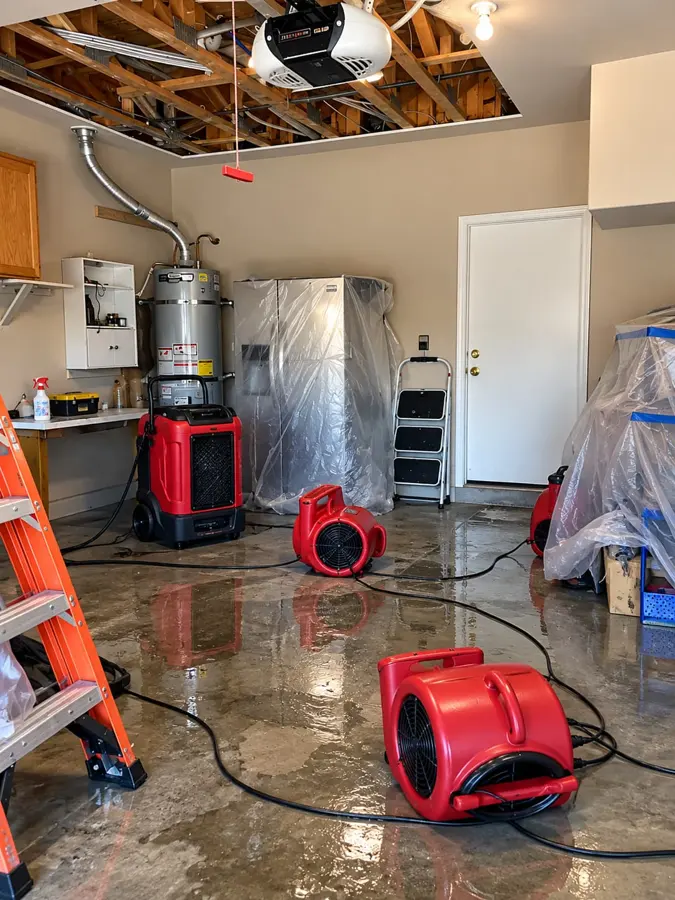
After the roof is covered, the restoration team deals with the water that already got in. A roof leak water damage job usually starts at the attic and works down.
Attic and ceiling
Soaked insulation is usually removed rather than dried in place, and stained or sagging ceiling drywall is cut out in sections. A ceiling leak water damage job also checks the framing above it.
- Wet insulation is bagged and removed.
- Sagging or stained drywall is cut out in sections.
- Rafters and the roof deck are checked with a moisture meter and dried.
Drying and readings
The team sets air movers and dehumidifiers, checks the readings each day and removes the equipment only when the wet framing reads dry. The median Milan home was built in 1969, and about 1,592 homes date from before 1980, so the framing under the roofing spans several decades of building.
The claim file after a storm
Wind damage and the rain that follows are often handled under different parts of a policy, so the order of events matters. A dated record settles most questions about what came first.
- The date of the storm and the National Weather Service report for it
- Photos of the roof, the siding and every ceiling stain
- Roofer estimates and receipts for temporary repairs
- The restoration team's moisture readings and removal records
Before the next storm
Severe weather returns every spring and summer, and a short check afterward catches small openings before the next rain.
- Look from the ground for lifted or missing shingles, loose flashing and open vents after any severe storm.
- Check the attic after storms for stains, damp insulation or daylight where there should be none.
- Trim limbs that hang over the roof so they cannot strike it in high wind.
- Know who to call before the rain: the Milan water damage pros handle drying and cleanup at any hour.
Questions
Did the March 2025 tornado hit inside Milan?
The National Weather Service describes a neighborhood along Wabash Road, south of Milan. It reports siding damage and lost roofing materials on a couple of homes, plus snapped trees and limbs.
What does an EF0 rating mean?
EF0 is the lowest rating the National Weather Service gives a tornado. Even so, the March 2025 tornado's peak winds were estimated at 85 mph, enough to strip roofing and siding.
Can a ceiling stain wait until the roof is fixed?
The roof repair stops new water, but wet insulation and drywall keep holding moisture. Mold can start in damp materials within 24 to 48 hours, so the wet layers need attention soon after the roof is covered.
Is wind driven rain covered by homeowners insurance?
That depends on the policy and on how the opening formed. Many policies cover rain damage that follows a storm opening in the roof, but the wording decides, so the insurer should be asked early.
How long do wet ceilings take to dry?
Usually several days once the wet insulation and drywall are removed. The framing, the weather and the readings decide when the equipment can leave.
Why did a ceiling stain appear far from the damaged part of the roof?
Water runs along rafters, the roof deck and the top of walls before it drops. The stain shows where the water finally came through, not where the roof was opened.